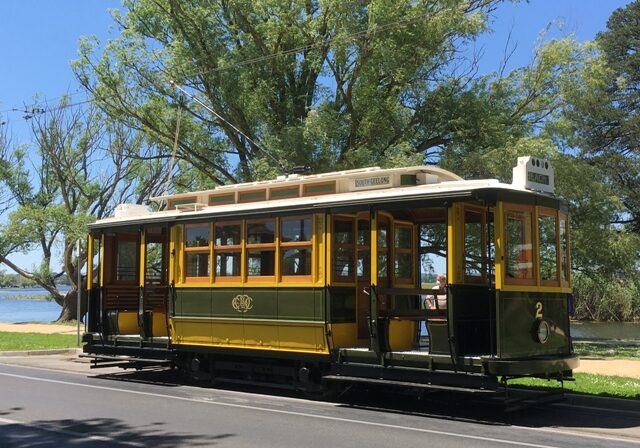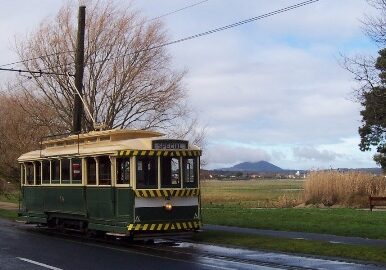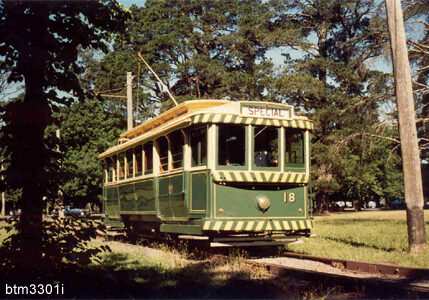
Built in 1916 by Duncan and Fraser for the Hawthorn Tramways Trust where it ran as No. 7. Renumbered 113 and classed “M” by the Melbourne and Metropolitan Tramways Board in 1920. Sold to the Electricity Supply Co. of Victoria Ltd. in 1931 and received its present number, passed on to the SEC in 1934.
-
MUSEUM STATUS
Pending installation of new air pipework and rewiring - stored.


History
1915 – Delivered to Hawthorn Tramways Trust as tram No 7.
1920 – Taken over by Melbourne & Metropolitan Tramways Board as No. 113, class M.
1930 – Sold to Electric Supply Co. of Victoria for use on the Ballarat tramway system as No. 28. Converted to an early form of one-man operation.
1934 – Ballarat tramway system formally taken over by the SEC.
1938 – Converted to final Ballarat form – waist level panels in drop ends, with closeable doors in each corner of the tramcar.
1971 – Acquired by the BTPS.
1978 – Returned to service after repairs, painted in the early 1950’s SEC colour scheme
1999-2002 – Repainted to ESCo colours completed.
2025 – Withdrawn from service for a mechanical and electrical overhaul and stored off site.
Historical Significance
-
HISTORIC
Tram built for the developing eastern suburbs of Melbourne in 1916, but became surplus to needs in Melbourne and sold to Ballarat in 1930 to replace by then the worn out ESCo trams. The four wheel tram is synonymous with Ballarat serving the city and its community from 1930 until 1971. It was converted to operate in Ballarat for one man operation, with doors on each side of both ends. Painted by the BTM and minor modifications made to represent the 1930’s era of the SEC operations, different livery to that of the 1950’s.
-
TECHNICAL
shows how the type underwent modifications and an earlier colour scheme in Ballarat though the door pillars and the internal layout in the ends have not been relocated back to their positions when received from Melbourne and first modified by the SEC.
-
PROVENANCE
known in detail – see Fleet Register sheet.
-
SOCIAL
One of the fleet of four wheelers that served Ballarat.
-
RARITY
One of small number of similar trams in Australian tramway museums.
-
condition integrity
remains in operable condition.
-
interpretive potential
shows the form and colour scheme of Ballarat Trams in the early 1930’s and can be used in Wendouree Parade for visitor hands on experience.
-
conservation plan
Reconstruct to transition stage between 26 and 27 (i.e. from an open California combination to become an enclosed tramcar) and paint in ESCo colours.
-
Line Breaker
Not fitted
Technical Details
-
TYPE
Single truck, drop ends, open California combination
-
TRUCK (BOGIE)
Brill 21E
-
WHEEL SIZE
33" nominally (840mm)
-
WHEELBASE
7' 6" (2.29m)
-
LENGTH
31' 10" (9.70m)
-
WIDTH
8' 11" (2.72m)
-
BOGIE CENTRES
7'6" (2.29m)
-
APPROXIMATE MASS
12 tons (12.2 tonnes)
-
motors
Westinghouse 225
-
controllers
Westinghouse T1F
-
brake valves
General Electric SL1
-
compressor
General Electric CP25
-
compressor governor
General Electric MLA1
-
passenger capacity
40