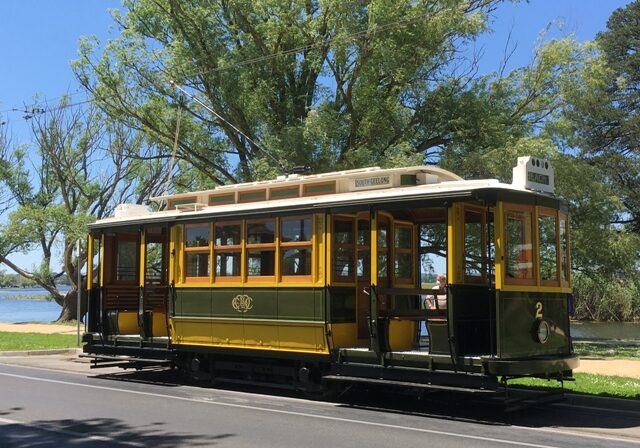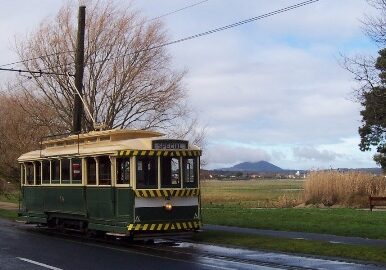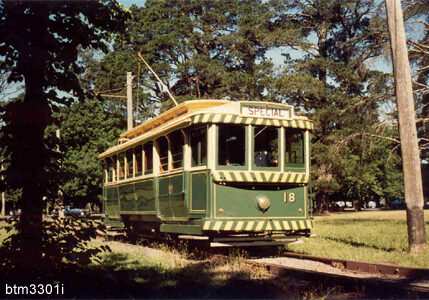
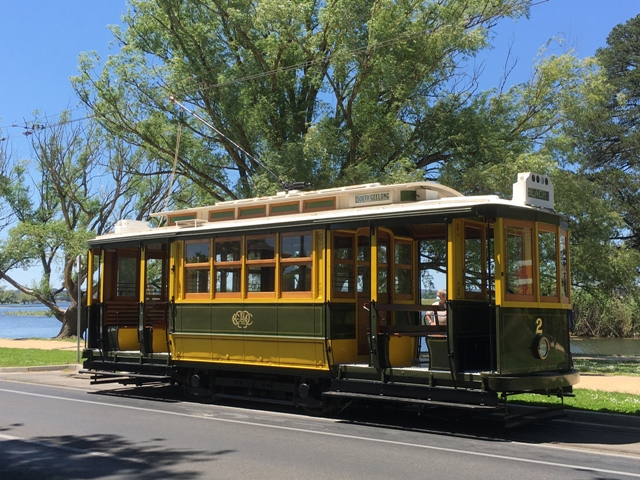
The tramcar was converted back to the open ended style that lasted until 1935 and is in what the donor of the tram deduced to be the Melbourne Electric Supply Company’s colour scheme.
The tram is fitted with a former Brussels Tramway’s version of a Brill 21E four-wheel truck. Over 400 of these were built in the 1930’s for the “Les Tramways Bruxellois” in Belgium.
The truck was acquired through the Sydney Tramway Museum. Bendigo Tramways undertook the electrical wiring and air piping on the tram. It was commissioned in Bendigo before the tram was transported to Ballarat where the final touches have been made.
-
MUSEUM STATUS
Operational vehicle for special use occasions.


History
1912 – Body built by Duncan and Fraser of Adelaide and railed in KCD condition to the Melbourne Electric Supply Co. (MESCo) depot in Geelong. Separate contractors supplied and fitted the electrical and mechanical equipment.
1914 – Roller type destination boxes fitted with 4 lights above, signalling the 3 route destinations at the time: West (red), Newtown (green) and South (white). The 4th light (blue) was for the East route that was planned for a tramway takeover of the MESCo’s buses before the close of the decade.
mid to late 1920’s – Fitted with air brakes to replace the magnetic brakes. Side destination boxes moved from right hand clerestory windows to roof near the leading ends of the car. Plywood advertisement racking extended to motorman’s bulkhead which had green glass covered by notice board (central) and ply (right side) with the instruction TO STOP TRAM PULL BELL CORD ONCE painted on. Central drop window in motorman’s bulkhead replaced by half window with sliding shutter. Seats provided for motormen.
1930 – MESCo taken over by the State Electricity Commission (SEC) on 1 October.
1935 – Converted to one man operation. Platform ends enclosed except for one doorway each side and off-side pillar beside motorman moved back one roof rib at each end to enlarge entry way. Off-side one-third of the motorman’s bulkhead removed. Folding lattice gates that lifted steps fitted to the 4 entry/exit points. Tip over seats replaced by wooden longitudinal seating in the saloon and aisle cut through the transverse seat on the platforms. The piece of seat cut out re-installed opposite the rear doorway. SEC logo replaced Geelong Electric Tramways insignia on tram sides, first applied in 1931.
late 1940’s – Bumper bars lowered to match those of the bogie trams. Tow bars, originally for the trailers, removed by now. Leather covered foam rubber laid on the wooden seating in the saloon. Solid backs installed on the shortened platform seats replacing original 2-rail backing.
March 1950 – Folding gates replaced by wooden swing doors on entryways. Rear doors narrowed slightly. Tail lights and windscreen wipers fitted. Route lights removed from destination boxes. Body colour changed to Bristol Green (a lighter shade) and pale cream.
March 1956 – Geelong tramway system closed, No. 2 making its last run during January 1956. Body subsequently sold to Phil Shoppee, a farmer at Murradoc on the Bellarine Peninsula.
1991 – Body acquired by Warrington Cameron reconstruction commenced.
2004 – Truck arrived at Bendigo Tramways who shortened the wheelbase, refurbished the roller bearings, replaced the larger CP29 compressor and had the wheels re-profiled. It was retained there for the next 16 years.
2020 – Electrical, air and mechanical equipment installed by the Bendigo Tramways.
2021 – Body work completed at the Ballarat Tramway Museum.
2022 – Formally launched on 6-2-2022.
Historical Significance
-
HISTORIC
This tram is the only one known to exist of the seven (and four trailers) that opened the Geelong system in 1912. It is the only former MESCo Geelong tram that has been reconstructed to its as-built body configuration and made operational.
-
TECHNICAL
body reconstructed using traditional methodologies. Uses a former Brussels wheel set and other modified former tramway equipment.
-
PROVENANCE
known in detail.
-
SOCIAL
Demonstrates the seating arrangements provided to Geelong passengers in 1912.
-
RARITY
The only operational tram built for MESCo in a tramway museum.
-
condition integrity
Body faithfully reconstructed though with different electrical and mechanical equipment to that originally provided.
-
interpretive potential
Enables Museum visitors to see an original Geelong tram and experience travel typical of 100 years ago.
-
conservation plan
Retain in the MESCo Colour Scheme and configuration.
Technical Details
-
TYPE
Single Truck straight sill open combination, modified by SEC to closed combination. As fitted 2019 - Single Truck drop end open combination)
-
TRUCK (BOGIE)
Brush. As fitted 2019 - Brussels Brill 21E type fitted with Roller bearings
-
WHEEL SIZE
33" from old photos. As fitted 2019 - 760mm Nominal
-
WHEELBASE
2.44m (8')
-
LENGTH
9.45m
-
WIDTH
As fitted 2019 - 2.62m over footboards, 2.5m at gutters (as measured)
-
APPROXIMATE MASS
12T approx
-
motors
2 x 45HP, Westinghouse 225N. As fitted 2019 - 2 x 49HP, MTV 343 Ateliers de Constructions Electriques de Charleroi (ACEC)
-
controllers
Westinghouse T1F. As fitted 2019 - K35 JJ
-
brake valves
Originally magnetic and hand. As fitted 2019 - Air - Westinghouse PV3 type
-
compressor
As fitted 2019 - Westinghouse DH10
-
passenger capacity
Seated 36, 20 standing + 2 crew.