Ballarat Begonia Festival
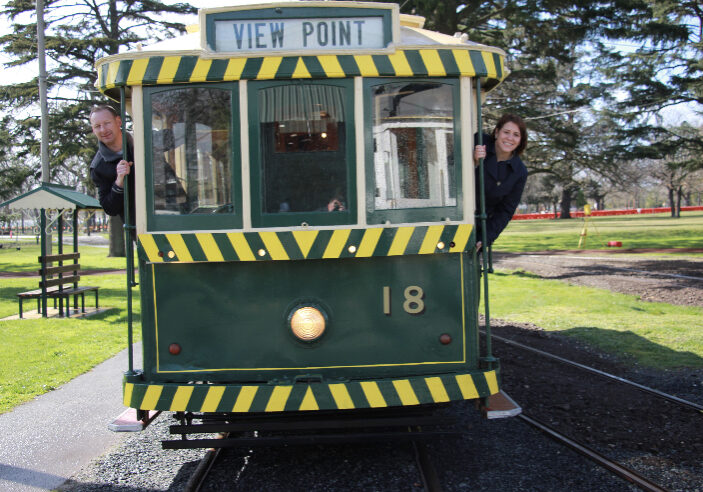
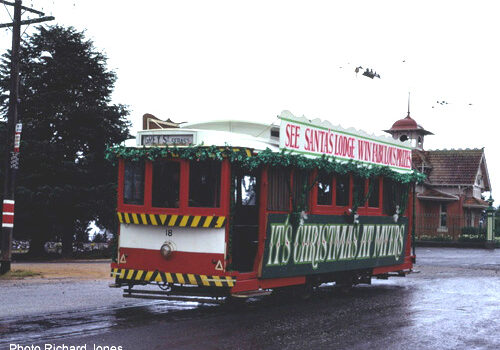
The Ballarat Begonia Festival celebrated its 60th anniversary in 2012. This article explains why the Begonia Festival was organised, and takes a detailed look at the first Festival in 1953. Changes to the Festival over the years are discussed, along with the role of Ballarat’s trams. The dates for the 2014 Festival are: Saturday 8 March 2014 to Monday 10 March 2014.
Why a Begonia Festival?
The Botanical Gardens were reserved on the western side of Lake Wendouree in 1858, seven years after the first Ballarat gold rush. The first reference the author has seen to begonias in the Botanical Gardens appeared in the “Ballarat Star” of 3 March 1887. An article “The lake and gardens” noted how thanks to the skill of the staff a succession of bloom is maintained throughout the year”. A description of the various flowers grown included “Begonias in fine variety with their beautiful leaves”.1
In December 1887 the horse trams commenced running. The Gardens became easily accessible both to Ballarat residents and visitors arriving at the Railway Station. Ballarat became a magnet for tourists at certain times of the year: during the Christmas-New Year period at the Gardens Reserve; in March when the annual Railway Picnics were held; and in October during the South Street Competitions and Band Championships. These influxes of visitors were good for hotels, shops and other local businesses.


1930s
By the 1930s the begonia displays at the Gardens were famous, and were the subject of postcards of Ballarat. In March 1938 a Floral Festival was held in Ballarat to celebrate the centenary of European settlement in the district.
Shops in the central business district, a tram and the Grenville Street tram shelter were decorated with waxed paper flowers.
The Floral Festival included some of the features seen in future Begonia Festivals: a floral carpet, Festival Queen, floral displays, and a street procession with floats along Sturt Street. On the day of the procession five thousand people came to Ballarat by special train.


Post War
During the early post-war years a leading Ballarat citizen Edgar Bartrop returned from an overseas tour where he had seen many fairs and festivals. His suggestion that such a festival be held in Ballarat was discussed by the Greater Ballarat Association, and later by the City Council.
At a public meeting on 18 September 1952 it was agreed that a “Ballarat Begonia Festival” would be held from 7-15 March the following year, and this would be an annual event. The central theme would be “Ballarat’s world-famous Begonias”. The aim was to “bring Ballarat’s great floral attractions before the people of Australia” and “attract many people to the city, especially in the Autumn when it was looking its best”.3
The First Begonia Festival, 1953
The 1953 Festival Program stated proudly: “The Begonia Festival of 1953 is the first of its type in Australia, and gives you the opportunity to see Ballaarat in a carnival mood, with its garden setting in the glorious Autumn time. The City will be at its best with the added magnificent display of Begonias at the Botanical Gardens”.
The official opening of the first Begonia Festival on Saturday 8 March 1953 was marked by the symbolic arrival of a Cobb & Co coach, completing a trip from Ballarat to Melbourne and Geelong then return. Large crowds flocked to North Gardens Reserve for “Music for the People”, directed by Hector Crawford (later a TV producer). The Lord Mayor of Melbourne congratulated the city on its foresight on organising the Festival. Imitation is the sincerest form of flattery, and the City of Melbourne organised its own Moomba Festival for the first time in 1955 – at the same time of year as the Begonia Festival.
Notices about the festival arrangements, Ballarat Courier 7 March 1953.


Monday 9 March was Labour Day. The first-ever Begonia Festival Procession was held along Sturt Street, finishing at the City Oval where cycling and athletic events were held. The trams were busy on that weekend. The “Ballarat Courier” noted: “Weekend traffic on trams was said to have been the greatest in this form of Ballarat transport”.4
On 12 March a crowd of about 20,000 attended the school children’s display at the City Oval to see children from local schools dancing and marching in costumes. The “Ballarat Courier” reported:
“It was reported yesterday that tram traffic for the children’s display at the City Oval on Thursday, combined with the usual daily travel on all routes, constituted a record high for passengers carried by Ballarat tramways on a weekday. The regular basic service was supplied by all cars normally held at the depot for routine inspection and servicing. The smooth flow of road traffic was in direct contrast with that experienced at the week-end when services were most disorganised. Twenty-six trams were in service on Thursday from 11.55 am to 5 pm. This represented the total number of trams in Ballarat, with the exception of one which remained in the depot”.5
Ballarat East also had some festival events. The Floral Carpet, which showed the Ballarat coat of arms, and various exhibitions were held at the Alfred Hall in Grenville Street (demolished in 1956). A miniature train and sideshows was held in Little Bridge Street. A “Monster Bonfire” and barbecue were held at Llanberris Reserve, and an evening carnival at the Eureka Stockade Reserve.
On the evening of Friday 13 March a large crowd attended the “Must-See” of the Festival, the Square Dancing Competition in Grenville Street. Saturday 14 March featured a Railway Picnic, which had last been held to Ballarat in 1939.
About 3,500 passengers came on three special trains from Melbourne, and one from Dimboola. A Highland Day was held at the City Oval, and the evening saw a street march along Sturt Street, the crowning of the Begonia Queen, and the unmasking of “Begonia Bill”.
Ballarat East also had some festival events. The Floral Carpet, which showed the Ballarat coat of arms, and various exhibitions were held at the Alfred Hall in Grenville Street (demolished in 1956). A miniature train and sideshows was held in Little Bridge Street. A “Monster Bonfire” and barbecue were held at Llanberris Reserve, and an evening carnival at the Eureka Stockade Reserve.
On the evening of Friday 13 March a large crowd attended the “Must-See” of the Festival, the Square Dancing Competition in Grenville Street. Saturday 14 March featured a Railway Picnic, which had last been held to Ballarat in 1939.
About 3,500 passengers came on three special trains from Melbourne, and one from Dimboola. A Highland Day was held at the City Oval, and the evening saw a street march along Sturt Street, the crowning of the Begonia Queen, and the unmasking of “Begonia Bill”.
The second Festival, 1954
The second Festival was marked by the unveiling on 5 March of the floral clock, located in Sturt Street between Armstrong and Doveton Street. The 1954 Festival Program stated proudly that “the clock will be the largest of its kind in the world” and ”be a constant reminder that Ballaarat is indeed the Garden City”. [The floral clock was moved to the Gardens in 1977.]
The second Festival is best remembered for the visit of the Queen and Prince Phillip to Ballarat on Saturday 6 March 1954. The “Royal Progress” took the Royal couple from the Ballarat Railway Station along Sturt and Sturt Street West to the Gardens (watched by a crowd estimated at 120,000 people), and tram and motor vehicle traffic was barricaded.
The Queen’s reported comment that “we grow begonias like saucers, you, like plates” gave plenty of good publicity. A shuttle service was operated on all tram routes during that period. After the departure of the Royal couple the trams were busy carrying passengers to and from the Gardens to the Begonia Festival.


The second Festival, 1954
The second Festival was marked by the unveiling on 5 March of the floral clock, located in Sturt Street between Armstrong and Doveton Street. The 1954 Festival Program stated proudly that “the clock will be the largest of its kind in the world” and ”be a constant reminder that Ballaarat is indeed the Garden City”. [The floral clock was moved to the Gardens in 1977.]
The second Festival is best remembered for the visit of the Queen and Prince Phillip to Ballarat on Saturday 6 March 1954. The “Royal Progress” took the Royal couple from the Ballarat Railway Station along Sturt and Sturt Street West to the Gardens (watched by a crowd estimated at 120,000 people), and tram and motor vehicle traffic was barricaded.
The Queen’s reported comment that “we grow begonias like saucers, you, like plates” gave plenty of good publicity. A shuttle service was operated on all tram routes during that period. After the departure of the Royal couple the trams were busy carrying passengers to and from the Gardens to the Begonia Festival.
On the Sunday the main attractions were “Music for the People” and the Begonia hothouse. The “Ballarat Courier” reported:
“Trams which ran at frequent intervals to deal with the abnormal number of travellers also found progress difficult. They had frequently to stop while cars were moved from the line, but drivers remained good-tempered and considerate throughout”.6


The sixth Festival, 1958
The sixth Festival was marked by the visit of the Queen Mother to Ballarat on Sunday 2 March 1958. To handle the expected crowds eight trams left the Railway Station after the first train arrived at 11.05 am, and normal tram services commenced at 12.30 pm.
The Royal train arrived at 4 pm, and tram and motor vehicle traffic was barricaded along the route of the “Royal Progress” (watched by a crowd estimated at 120,000 people). Afterwards people flocked to the Gardens for the Music for the People concert, and special trams ran during the afternoon to handle the crowds to and from the Gardens.7
On the following Sunday 9 March 1958 large crowds flocked to see “Youth on Parade”, a musical, choral and folk dancing program provided by youth groups and institutions. From 1 pm a ten minute tram service was operated from the city, and a 20-minute service operated during the evening in place of the usual 30-minute service.8

Information Sources
This article first appeared in the February 2012 (page 4) issue of the Museum's house magazine Fares Please! Additional photographs and images have been added to the website version. Photographs are drawn from the Museum's collection.
Photographs and images from the Museum's collection are individually credited. Items donated by: Alan Bradley, Pat Edwards, Earl Ewers, Richard Gilbert and Paul Nicholson.
References
- Acknowledgement is given to the Ballarat Municipal Library for its assistance in finding this first reference to Begonias in Ballarat.
- Ballarat Courier 28 June 1938
- ibid 19 September 1952
- ibid 10 March 1953
- ibid 14 March 1953
- ibid 8 March 1954
- ibid 27 February 1958
- ibid 10 March 1958
- ibid 26 February 1971
Text Alan Bradley, Layout Warren Doubleday